Simple Definition
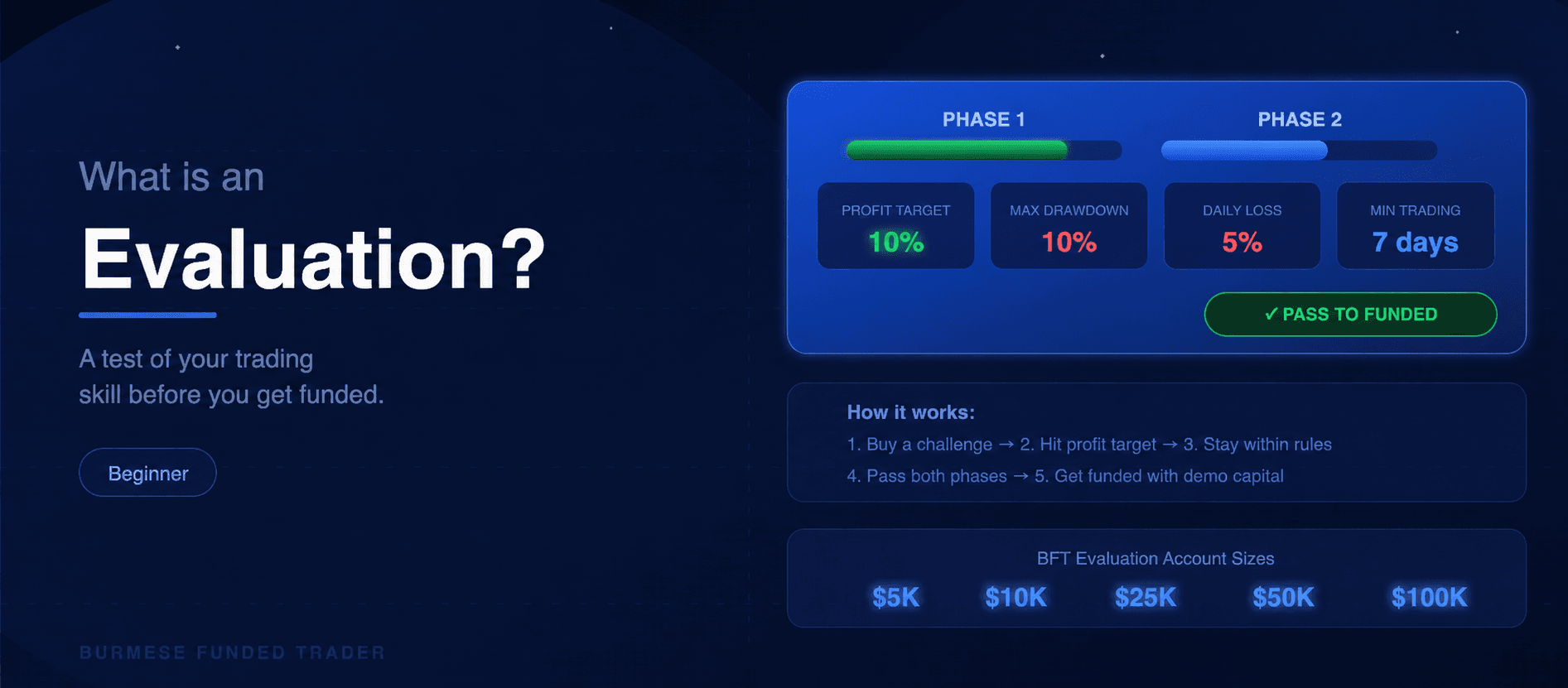
An evaluation is a rules-based process used by prop firms to assess a trader’s ability.
It is sometimes called a challenge, assessment, or trading combine, depending on the firm.
The purpose of an evaluation is not only to see whether a trader can make profit. It is also used to test whether the trader can manage risk, follow rules, and stay disciplined.
In many modern prop firm models, evaluations are completed in a simulated trading environment. For example, Topstep describes its Trading Combine as a rules-based simulated evaluation where traders prove trading skill while staying within loss limits.
This matters because traders should understand the account structure before joining any evaluation.
Why Prop Firms Exist
Prop firms use evaluations because they need a way to filter traders.
Not every trader is ready for larger account access or payout eligibility. Some traders may be emotional, overleveraged, inconsistent, or unable to follow rules.
An evaluation gives the firm a structured way to see whether a trader can:
- Follow instructions
- Manage risk
- Respect drawdown limits
- Trade with discipline
- Avoid prohibited strategies
- Perform under pressure
For traders, the evaluation gives a clear path. Instead of needing large personal capital, traders can prove themselves through a defined process.
But this process only works if the trader understands the rules before starting.
How It Works
Most prop firm evaluations follow several steps.
1. Select an Account Model
The trader chooses an evaluation model.
This may include:
- Account size
- Evaluation steps
- Profit target
- Drawdown rules
- Daily loss limits
- Trading permissions
- Payout structure
Different firms and account types may have different rules.
2. Trade the Evaluation Account
The trader then trades inside the evaluation environment.
The goal is to reach the required target while following every rule.
This is where many traders fail. They focus only on the profit target and ignore the risk rules.
A good evaluation trader does not ask only:
“How fast can I pass?”
A better question is:
“Can I pass while managing risk properly?”
3. Avoid Breaches
A breach happens when a trader breaks an important account rule.
Common breach causes may include:
- Hitting daily loss limit
- Hitting maximum drawdown
- Trading prohibited news events
- Holding trades when not allowed
- Using prohibited strategies
- Sharing account access
- Using bots or exploitative methods
- Violating position size or margin rules
Some breaches may be soft breaches. Others may be hard breaches that terminate the account.
4. Account Review
After the trader meets the evaluation requirements, the firm may review the account.
The review may check:
- Did the trader follow all rules?
- Was the trading behavior consistent?
- Was risk managed properly?
- Was there any prohibited trading?
- Was the account holder verified?
- Is the trader eligible for the next stage?
Passing is not only about the ending balance. It is about how the trader got there.
5. Move to the Next Stage
If approved, the trader may move to the next stage.
Depending on the firm, this may be a simulated funded stage, live funded stage, or another account structure.
Different firms use different evaluation and funded account models, so traders should always check the official rules.
What Traders Must Understand
Traders must understand that an evaluation is not a shortcut.
It is a rule-based test.
Before buying an evaluation, traders should know:
- The profit target
- The daily loss limit
- The maximum drawdown rule
- The minimum trading requirements
- The stop-loss rules
- The prohibited trading rules
- The payout review process
- The refund policy
- The account structure
Risk management is one of the most important parts. Investor.gov warns that day trading can result in substantial financial losses quickly, especially when traders make fast decisions or use leverage without proper control.
A trader can have good analysis and still fail an evaluation if they risk too much.
The purpose of an evaluation is not to reward gambling. It is to identify traders who can trade with discipline.
Common Misunderstandings
- “Evaluation means guaranteed funding.”
- No. The trader must meet requirements and pass review.
- “Profit target is the only rule.”
- No. Drawdown, daily loss, prohibited strategies, and account rules are just as important.
- “I can use any strategy if it makes money.”
- No. Most firms have prohibited trading rules.
- “If I pass, I automatically get paid.”
- No. Payouts are usually subject to rule compliance, verification, and review.
- “Evaluations are easy if I use high risk.”
- High risk may pass quickly sometimes, but it can also breach the account quickly.
BFT Perspective
At BFT, an evaluation is not treated as a gambling challenge.
It is a structured process for trader development.
BFT provides simulated trading evaluation programs. Traders do not manage live client capital through BFT unless BFT states otherwise in writing.
BFT wants traders to understand the rules before they trade. This includes drawdown, daily loss limits, stop-loss requirements, margin limits, prohibited strategies, and payout review.
A serious trader should not enter an evaluation with the mindset of “flip the account fast.”
A serious trader should enter with a plan:
- Protect the account
- Control risk
- Follow the rules
- Trade with discipline
- Think long term
Payouts are subject to rule compliance, verification, and payout review.
Nothing in this article is financial advice or a guarantee of profit.
Key Takeaways
- An evaluation is a rules-based process used to assess traders.
- The goal is to test profit, risk management, discipline, and rule-following.
- Reaching the profit target does not matter if rules are broken.
- Many modern evaluations are completed in simulated environments.
- Traders should understand the full rules before buying any evaluation.