Simple Definition
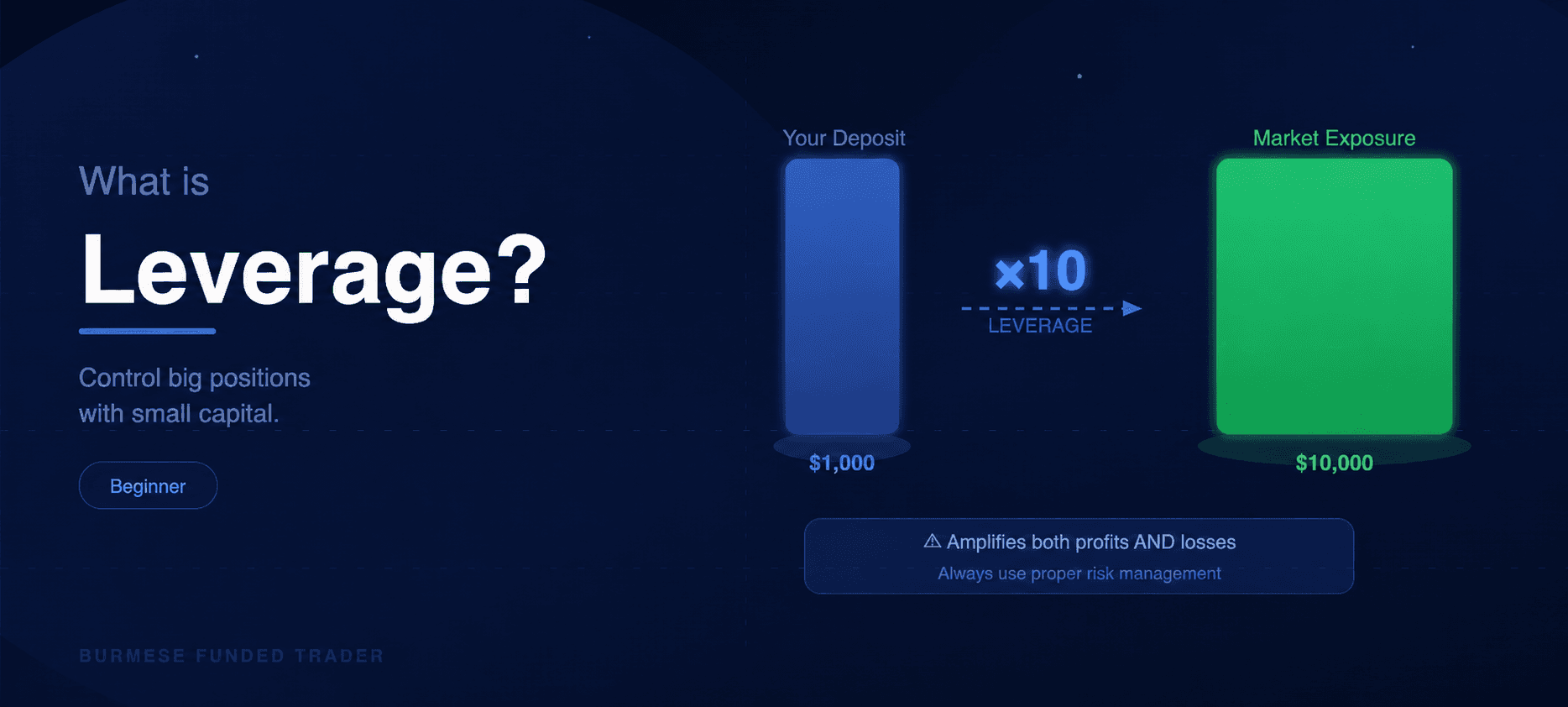
Leverage allows a trader to control a larger market position with a smaller amount of capital.
In simple terms, leverage increases your market exposure.
For example, if a trader uses 10x leverage, they may be able to control a position that is 10 times larger than the capital required to open the trade.
Leverage can make small price movements more meaningful. But it also increases risk. If the market moves against the trader, losses can happen faster.
This is why leverage should not be seen as free buying power. It is a tool that must be controlled.
Why This Matters
Many beginner traders misunderstand leverage.
They think leverage means:
“I can make more money with less capital.”
That is only one side of the story.
The other side is:
“I can lose money faster if I do not manage risk.”
Regulators and investor education sources repeatedly warn that leveraged trading can create large losses quickly, especially in fast-moving markets. Investor.gov explains that leveraged strategies are designed to magnify returns, but they also magnify risk.
This matters because many traders fail not because they cannot find entries, but because their position size is too large for their account.
Leverage does not make someone a better trader.
It only increases exposure.
How It Works
Let’s say a trader has $100.
Without leverage, they may only be able to control a $100 position.
With 10x leverage, they may be able to control a $1,000 position.
That means the trader has more exposure to price movement.
If the market moves in the trader’s favor, the profit may be larger compared to using no leverage. But if the market moves against the trader, the loss may also be larger.
Leverage is commonly used in:
- Forex trading
- Gold trading
- Index trading
- Futures trading
- CFD-style products
- Margin accounts
In many markets, leverage is connected to margin. Margin is the amount required to open or maintain a leveraged position. FINRA explains that when trading on margin, a brokerage firm lends funds using account assets as collateral.
The important point is simple:
Leverage controls position size. Risk management controls survival.
Simple Example
Imagine a trader has a $1,000 account.
They use 10x leverage and open a position worth $10,000.
If the market moves 1% in their favor, the position gains about $100.
That is a 10% gain on the trader’s $1,000 account.
But if the market moves 1% against them, the position loses about $100.
That is a 10% loss on the account.
The market only moved 1%, but the trader’s account moved 10%.
This is why leverage can be dangerous. A small market move can become a large account impact.
Common Mistakes
Common beginner mistakes include:
- Using high leverage without understanding exposure
- Thinking leverage increases skill
- Opening positions that are too large
- Trading without a stop loss
- Ignoring margin requirements
- Holding losing trades too long
- Increasing size after a loss to recover quickly
The biggest mistake is treating leverage like opportunity instead of risk.
A disciplined trader asks:
“How much can I lose if this trade goes wrong?”
before asking:
“How much can I make?”
BFT Perspective
At BFT, leverage should be understood as a risk tool, not a shortcut.
In evaluation trading, traders are not only judged by whether they can make profit. They are also judged by whether they can follow rules, manage exposure, and avoid reckless behavior.
A trader who uses too much leverage may hit drawdown limits, margin limits, or risk exposure rules very quickly.
That is why understanding leverage is important before joining any evaluation program.
BFT’s view is simple:
Leverage does not prove discipline. Risk management does.
The goal is not to use the biggest size possible.
The goal is to trade with control.
Key Takeaways
- Leverage allows traders to control a larger position with less capital.
- Leverage can increase both gains and losses.
- Small market movements can have a large account impact when leverage is high.
- Leverage should always be combined with stop losses and position sizing.
- A disciplined trader manages exposure before entering the trade.