Simple Definition
A market is where buyers and sellers trade something.
In trading, different markets allow people to buy and sell different financial assets. Some traders trade company shares. Some trade currencies. Some trade gold, oil, crypto, or other products.
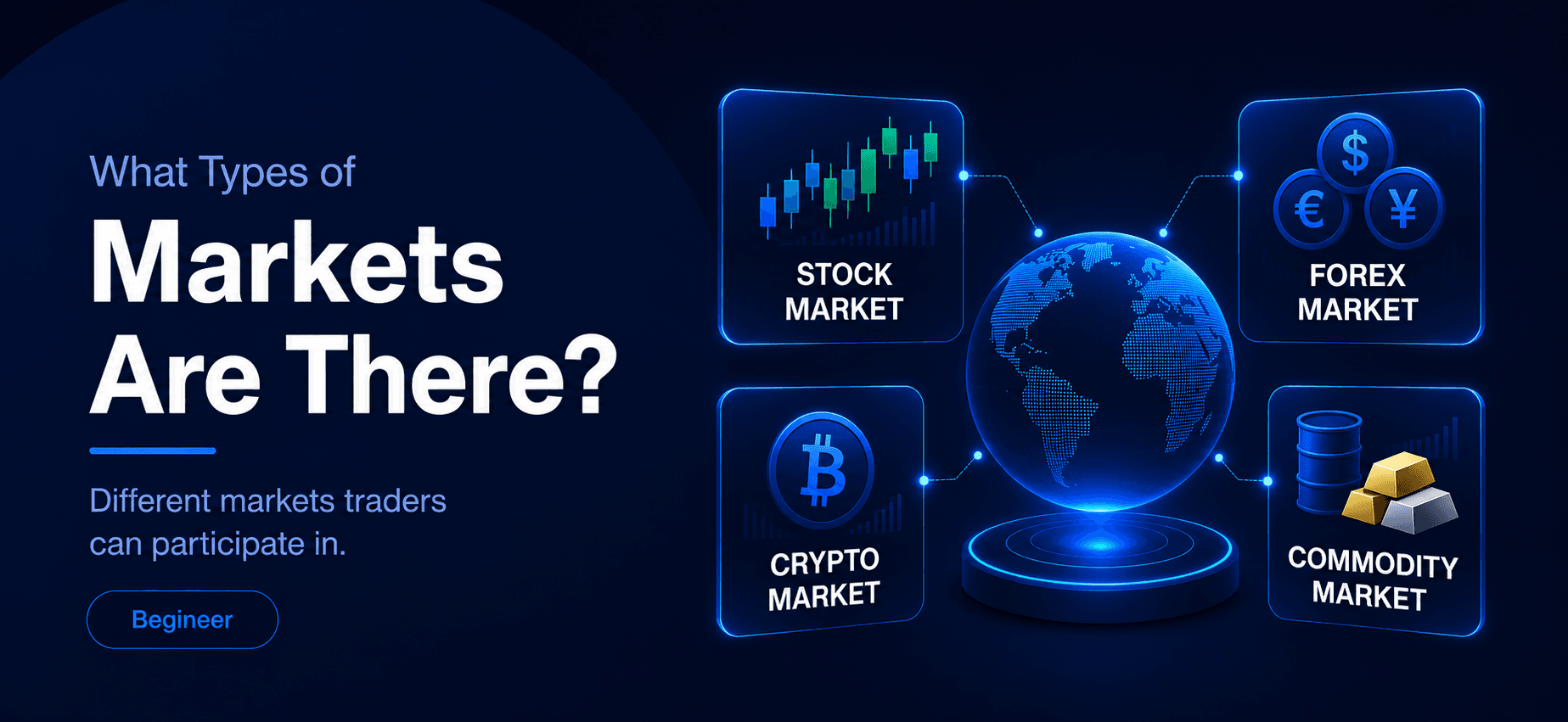
For beginners, the four common market types to understand first are:
- Stock market
- Forex market
- Crypto market
- Commodity market
Each market works differently. Each one also has its own risks.
Why This Matters
Many beginners enter trading without knowing what market they are actually trading.
That is a problem.
A trader who trades gold needs to understand that gold can move aggressively during economic news. A trader who trades forex needs to understand currency pairs. A trader who trades crypto needs to understand high volatility. A trader who trades stocks needs to understand company shares.
Different markets require different behavior.
Before choosing what to trade, beginners should understand the basic differences between each market.
How It Works
1. Stock Market
The stock market is where people buy and sell shares of companies.
When someone buys a stock, they are buying a small ownership share in that company. Investor.gov explains that stocks are securities that represent ownership in a company. (Investor.gov)
Examples of stocks include:
- Apple
- Tesla
- Microsoft
- Other public companies
Stock prices can move because of company earnings, news, market sentiment, economic conditions, and investor demand.
A stock trader may try to profit from short-term price movement. A long-term investor may buy stocks to hold for many years.
2. Forex Market
The forex market is where currencies are bought and sold.
Forex stands for foreign exchange.
Examples of currency pairs include:
- EUR/USD
- GBP/USD
- USD/JPY
When a trader trades forex, they are trading one currency against another.
For example, EUR/USD shows the value of the euro compared to the U.S. dollar.
The forex market is popular because it is active and liquid, but it also carries risk. The CFTC warns that forex trading can be risky and that many retail forex customers lose money after costs, fees, spreads, and financing charges. (CFTC)
3. Crypto Market
The crypto market is where traders buy and sell digital assets.
Examples include:
- Bitcoin
- Ethereum
- Other cryptocurrencies
Crypto markets are known for strong price movement. This can attract traders, but it also creates risk.
Crypto prices can move quickly because of news, regulation, liquidity, market sentiment, exchange issues, and speculation.
The CFTC warns that many virtual currency markets operate through internet-based platforms that may be unregulated or unsupervised. (CFTC)
Beginners should be careful with crypto, especially when using leverage.
4. Commodity Market
The commodity market includes raw materials and natural resources.
Examples include:
- Gold
- Silver
- Oil
- Wheat
- Corn
Commodities can be traded directly, through futures contracts, or through other financial products. Investor.gov explains that commodity futures contracts are agreements to buy or sell a specific quantity of a commodity at a specific price on a future date. (Investor.gov)
Gold is one of the most popular commodities among retail traders.
Commodity prices can move because of supply and demand, inflation, interest rates, global events, war, weather, and economic data.
Simple Example
Let’s say four traders are watching the market.
Trader A trades Apple stock because they follow company news.
Trader B trades EUR/USD because they understand currency movement.
Trader C trades Bitcoin because they like crypto volatility.
Trader D trades gold because they focus on commodities and economic news.
All four are traders, but they are not trading the same market.
That means their risk, timing, strategy, and decision-making can be different.
Common Mistakes
Common beginner mistakes include:
- Trading a market without understanding how it works
- Choosing a market only because it looks exciting
- Trading crypto with too much leverage
- Trading forex without understanding currency pairs
- Trading gold during news without risk control
- Thinking every market moves the same way
- Copying another trader without understanding what they are trading
The market you choose matters.
A beginner should not only ask:
“What can make money?”
A better question is:
“What market do I understand enough to trade with risk control?”
BFT Perspective
At BFT, we believe beginners should understand the market before they trade it.
Trading is not just pressing buy or sell. A trader should understand what they are trading, why price moves, what risks are involved, and how much they can lose if the trade goes wrong.
BFT is built around trader development. That means learning first, managing risk, and then proving yourself through discipline.
Nothing in this article is financial advice or a guarantee of profit.
Key Takeaways
- A market is where buyers and sellers trade financial assets.
- The stock market involves company shares.
- The forex market involves currency pairs.
- The crypto market involves digital assets.
- The commodity market involves raw materials like gold, silver, oil, and agricultural products.
- Different markets have different risks.