Simple Definition
A payout is the money a trader may receive from a prop firm after meeting the firm’s requirements.
In simple terms, a trader joins an evaluation, follows the rules, trades profitably, and then requests a payout if they are eligible.
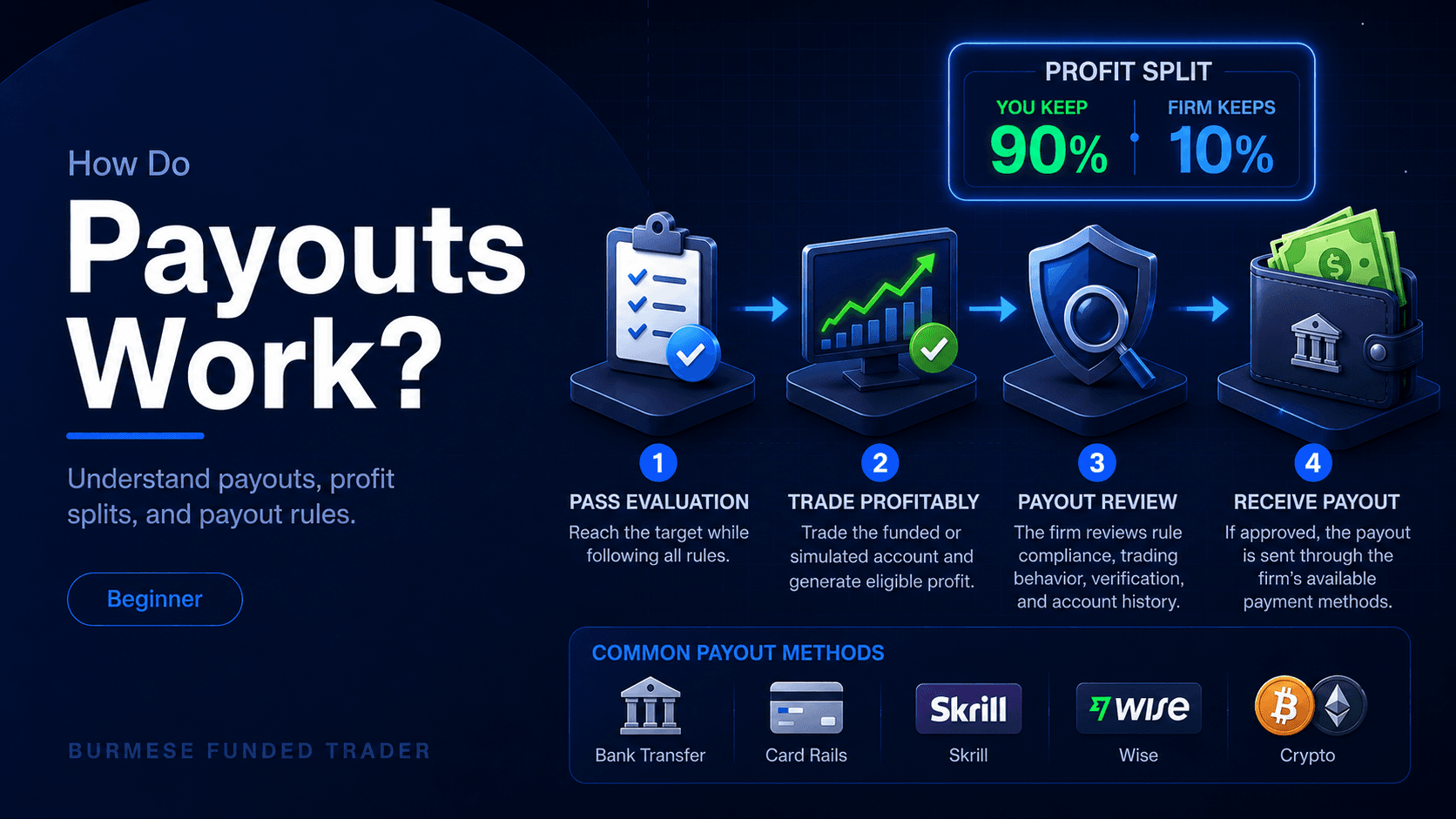
Most modern online prop firms use something called a profit split. This means the trader keeps a percentage of eligible profits, and the firm keeps the rest.
For example, if a firm offers a 90% profit split, the trader may keep 90% of approved profit, while the firm keeps 10%.
But every firm is different. Some firms offer 80%. Some offer 90%. Some may change the split depending on the account type, add-ons, scaling plan, or trader status. Topstep publicly advertises that traders can keep up to 90% of profits, while FTMO/OANDA states that eligible traders may withdraw 80% of simulated profit on its rewards account.
Why Prop Firms Exist
Prop firms exist to give traders a structured way to prove their skill.
The firm does not usually pay someone just because they open an account. The trader must first show that they can follow the firm’s process.
That process usually includes:
- Passing an evaluation
- Following trading rules
- Managing drawdown
- Avoiding prohibited strategies
- Completing verification
- Passing payout review
The payout system is the reward side of that structure.
For the trader, it creates a way to earn performance-based rewards without needing a large personal account from the beginning.
For the firm, it helps identify traders who can follow rules and manage risk.
This is why payouts are not just about making profit. They are also about how the profit was made.
How It Works
Most prop firm payouts follow a simple process.
1. Trader Passes the Evaluation
First, the trader must pass the firm’s evaluation or challenge.
This usually means reaching a target while staying within rules such as drawdown limits, daily loss limits, and trading restrictions.
2. Trader Moves to a Funded or Simulated Funded Stage
After passing, the trader may move to the next stage.
This stage can be different depending on the firm.
Some firms use live accounts.
Some use simulated funded accounts.
Some use a hybrid model.
This is important. A “funded account” does not always mean the trader is directly trading live capital. FTMO states that it provides simulated trading and educational tools only, and also says the accounts it provides are demo accounts with fictitious funds in a simulated environment.
Even Topstep, which has both simulated and live funded structures, reported that only 0.71% of individual participants trading in an Express Funded Account were called up to a Live Funded Account in its 2025 statistics. That statistic is specific to Topstep, but it shows why traders should not assume that every funded account is automatically live capital.
3. Trader Makes Eligible Profit
The trader then trades the funded or simulated funded account.
If the trader makes profit and stays within all rules, they may become eligible to request a payout.
4. Firm Reviews the Payout Request
Before paying, the firm may review the account.
This review may include:
- Rule compliance
- Trading behavior
- Account history
- Prohibited strategy checks
- Identity verification
- Payment method confirmation
5. Trader Receives the Approved Payout
If approved, the firm sends the payout through its available payment methods.
Payment methods vary by firm. FTMO lists options such as bank wire transfer, Visa Direct / Mastercard Send, Skrill, and cryptocurrencies for reward withdrawals, while other firms may use methods such as bank transfer, ACH, Wise, crypto, or local payment partners depending on country and policy.
What Traders Must Understand
Traders must understand that payouts are not automatic.
A trader may see profit in the account, but that does not always mean the payout is immediately approved.
Each firm may have its own payout rules, such as:
- Minimum payout amount
- Maximum payout cap
- First payout waiting period
- Payout frequency
- Required trading days
- Consistency rule
- Verification requirement
- Profit split percentage
- Prohibited trading review
- Account breach policy
For example, one firm may allow payouts every 14 days. Another may require a longer waiting period. One firm may have a payout cap. Another may allow larger payouts after scaling.
This is why traders should read the payout policy before joining.
A payout is not a salary.
It is not guaranteed income.
It is usually a performance-based reward subject to rules and review.
Common Misunderstandings
- “If I make profit, I automatically get paid.”
- Not always. Most prop firms review rule compliance, verification, and trading behavior before approving payouts.
- “Every funded account is a real live account.”
- Not always. Many modern prop firms use simulated funded accounts, live accounts, or hybrid models.
- “90% profit split means every firm pays 90%.”
- No. Profit splits vary by firm, account type, add-ons, and payout rules.
- “I can trade any way I want as long as I make money.”
- No. If the trading style violates firm rules, payout may be delayed, reduced, or rejected.
- “Payout means guaranteed income.”
- No. Trading involves risk, and payouts depend on performance, rules, verification, and review.
BFT Perspective
At BFT, payouts should be understood clearly before a trader enters any evaluation.
BFT provides simulated trading evaluation programs. Traders do not manage live client capital through BFT unless BFT states otherwise in writing.
The goal is not to make traders believe payouts are easy or guaranteed. The goal is to help traders understand the process.
A disciplined trader should know:
- How the payout split works
- When payout can be requested
- What rules must be followed
- What can delay or reject a payout
- Why verification matters
- Why trading behavior matters
Payouts are subject to rule compliance, verification, and payout review.
Nothing in this article is financial advice or a guarantee of profit.
Key Takeaways
- A prop firm payout is a performance-based reward traders may receive after meeting requirements.
- Many firms use profit splits such as 80% or 90%, but the exact split depends on the firm.
- Funded accounts may be simulated, live, or hybrid depending on the company.
- Payout methods can include bank transfer, card rails, Skrill, Wise, crypto, or other approved methods depending on the firm.
- Payouts are subject to rules, verification, and review.