Simple Definition
A prop firm, short for proprietary trading firm, is a company that gives traders a way to trade under the firm’s structure.
In traditional finance, a proprietary trading firm usually trades using its own capital. FINRA describes a proprietary trading firm as a firm that trades its own capital, does not have customers, and uses firm funds in firm accounts.
For a complete beginner, think of it like this:
A normal trader uses their own money to trade.
A prop firm creates a system where traders can prove their skill under rules.
If the trader performs well and follows the firm’s process, they may become eligible for rewards or a next stage.
A simple comparison is a football club tryout.
The club does not let every person play in the main team immediately. First, players must show skill, discipline, and the ability to follow instructions. A prop firm works in a similar way for traders.
Why Prop Firms Exist
Prop firms exist because trading skill is difficult to judge from words alone.
Anyone can say:
“I know how to trade.”
But a firm needs to see whether the trader can actually trade with discipline.
That is why many modern prop firms use evaluation programs. Instead of giving traders access immediately, the firm gives them a structured environment where they can test their skills.
This solves two problems.
For traders, it gives them a way to prove themselves without needing a large personal account from the beginning.
For the firm, it helps filter traders who can follow a system from traders who are only gambling.
Traditional prop firms may train traders, hire them, and allow them to trade firm capital. Modern online prop firms often use simulated evaluation environments, rule-based challenges, and payout-review systems instead. Topstep, for example, publicly describes evaluation and funded-account structures with rules, payout eligibility, and simulated-performance disclosures.
So when people say “prop firm,” they may be talking about different models.
That is why beginners should understand the difference before joining one.
How It Works
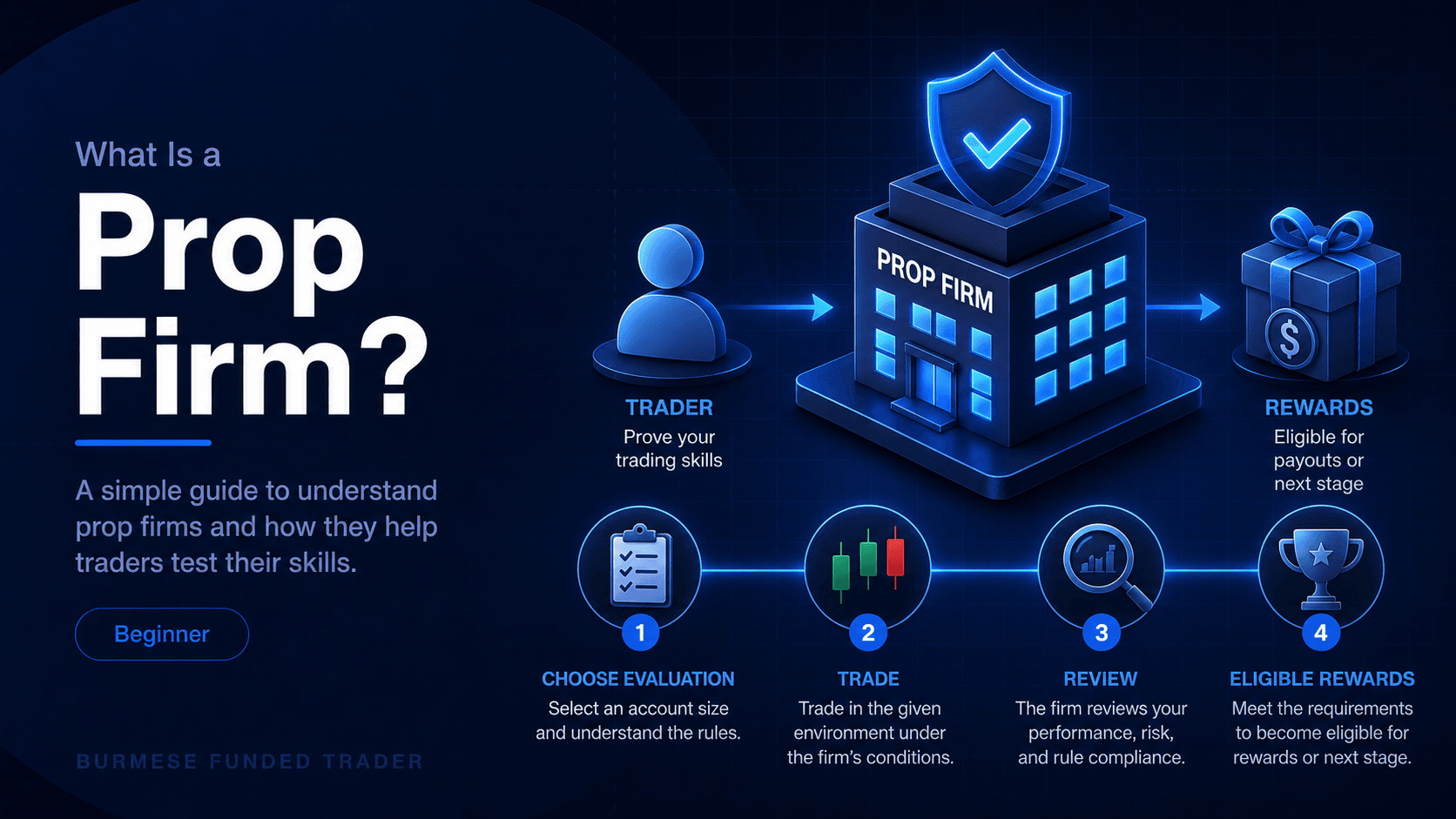
A modern online prop firm usually works in a few simple steps.
1. The Trader Chooses an Evaluation
The trader selects an account size or evaluation model.
This is not the same as opening a normal broker account. The trader is entering a rules-based test.
The firm tells the trader:
“Here is the account structure. Here are the limits. Here is what you need to do. Here is what you cannot do.”
2. The Trader Trades in the Given Environment
The trader then trades under the firm’s conditions.
In many modern prop firms, this environment may be simulated. That means the trader is not always trading live capital directly. Instead, the account may be used to measure performance, discipline, and rule-following.
This is important because the word “funded” does not always mean the same thing across the industry.
Some firms may use live accounts.
Some firms may use simulated accounts.
Some firms may use a mix.
A trader should always read the firm’s official explanation.
3. The Firm Reviews Performance
The firm checks whether the trader met the requirements.
It is not only about making profit.
The firm may also review whether the trader followed the process, respected risk limits, avoided prohibited behavior, and completed verification.
This is similar to passing a driving test. The examiner does not only check whether you reached the destination. They also check whether you followed the rules on the way.
4. The Trader May Become Eligible for Rewards
If the trader meets the requirements, they may become eligible for a payout, reward, or next stage depending on the firm’s model.
This is why prop firms attract traders who want to test their skills without needing a large amount of personal capital first.
But this does not mean profit is guaranteed.
Trading involves risk, and Investor.gov warns that short-term trading and leveraged strategies can lead to substantial losses, especially when traders do not understand the risks involved.
What Traders Must Understand
A prop firm is not free money.
It is not a shortcut.
It is not a guarantee that a trader will get paid.
A trader must understand a few basic things before joining:
First, the firm has its own rules. Even if the trader makes profit, breaking rules can still cause problems.
Second, the account may be simulated, live, or hybrid depending on the company. Traders should not assume every “funded account” means live capital.
Third, payouts are usually subject to review. The firm may check trading behavior, identity verification, account activity, and rule compliance before approving a payout.
Fourth, trading itself is risky. A prop firm can give structure, but it cannot remove market risk or emotional risk.
A good prop firm trader does not think only about passing.
They think about:
- Can I follow the rules?
- Can I manage risk?
- Can I stay disciplined?
- Can I trade without gambling?
That is the real test.
Common Misunderstandings
- “A prop firm is the same as a broker.”
- A broker gives access to the market. A prop firm gives a structured trading evaluation or trader program.
- “A funded account always means live capital.”
- Not always. Some modern prop firms use simulated funded accounts or mixed structures.
- “If I make profit, I automatically get paid.”
- Not always. Payouts are usually subject to rule compliance, verification, and payout review.
- “Prop firms are easy money.”
- No. Prop firm trading requires discipline, risk management, and the ability to follow rules.
- “The only thing that matters is passing fast.”
- Passing fast by gambling is not the same as trading well. A trader still needs a process.
BFT Perspective
At BFT, we view prop firms as a way for traders to test their skills through structure, discipline, and risk management.
BFT provides simulated trading evaluation programs. Traders do not manage live client capital through BFT unless BFT states otherwise in writing.
For BFT, the goal is not to make traders believe trading is easy. The goal is to help traders understand the process before they enter it.
A trader should learn what trading is, understand market risk, know how prop firms work, and then decide whether an evaluation fits their current skill level.
Payouts are subject to rule compliance, verification, and payout review.
Nothing in this article is financial advice or a guarantee of profit.
The simple idea is:
Learn first. Manage risk. Prove yourself.
Key Takeaways
- A prop firm gives traders a structured way to test their trading skills.
- Traditional prop firms usually trade firm capital, while many modern online prop firms use evaluation programs.
- Some modern prop firm accounts may be simulated, live, or hybrid depending on the company.
- Payouts are usually subject to rules, verification, and review.
- A prop firm is not guaranteed income. It is a test of discipline, risk management, and rule-following.