Simple Definition
Risk management is the process of controlling how much a trader can lose before entering a trade.
It is one of the most important parts of trading.
Many beginners focus only on entries. They ask:
- Where should I buy?
- Where should I sell?
- What pair should I trade?
- What strategy should I use?
But professional traders think differently.
They ask:
- How much am I risking?
- Where is my stop loss?
- What happens if this trade loses?
- Can my account survive a losing streak?
- Does this trade follow my plan?
Risk management does not guarantee profit. But it helps traders avoid large, uncontrolled losses.
Why This Matters
Trading involves risk. Even good traders lose trades.
The difference is that disciplined traders control their losses. Undisciplined traders allow one bad trade, one emotional decision, or one oversized position to damage the account.
Investor.gov warns that day trading can result in substantial financial losses in a short period of time, and leveraged trading can make losses happen even faster.
This is why risk management matters.
A trader does not need to win every trade to survive. But they must avoid losing too much on one trade.
Risk management is what keeps traders in the game long enough to improve.
How It Works
Risk management usually includes several parts.
1. Risk Per Trade
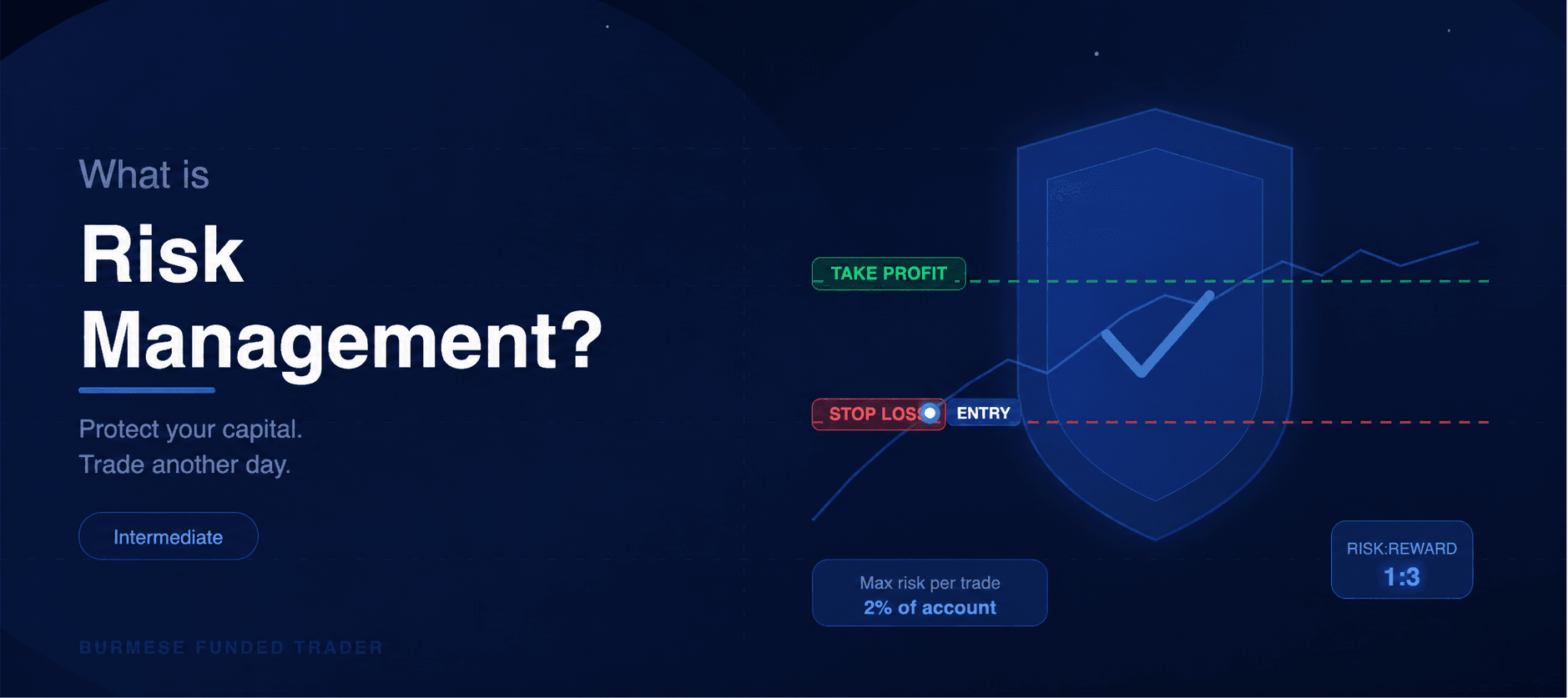
This means deciding how much of the account you are willing to lose on one trade.
For example, a trader may decide to risk only 1% of the account on a trade.
If the account is $10,000, then 1% risk equals $100.
This means if the trade hits the stop loss, the planned loss should be around $100.
2. Stop Loss
A stop loss is a planned exit point if the trade goes wrong.
It helps prevent one losing trade from becoming a much bigger loss.
A stop loss does not guarantee perfect execution in every market condition because slippage can happen, especially during fast-moving markets. But it still gives the trader a defined risk plan.
3. Position Sizing
Position sizing means choosing the correct trade size based on the risk amount and stop-loss distance.
A trader should not choose size randomly.
The position size should answer this question:
If my stop loss gets hit, how much will I lose?
That is the real risk.
4. Daily Loss Limit
Some traders set a maximum amount they are willing to lose in one day.
For example:
If I lose 2 trades or lose 2% in one day, I stop trading.
This prevents emotional trading after losses.
5. Trade Plan
A trade plan helps traders avoid random decisions.
A basic trade plan includes:
- Entry reason
- Stop loss
- Target
- Risk amount
- Trade setup
- Reason to exit
- Maximum daily loss
Without a plan, traders often react emotionally.
Simple Example
A trader has a $10,000 account.
They decide to risk 1% per trade.
That means the maximum planned loss is $100.
The trader finds a setup with a stop loss that is 20 points away.
Now the trader must choose a position size where a 20-point loss equals about $100.
If they choose too much size, the trade may lose more than planned.
If they choose correct size, the trader can take the trade knowing the risk before entering.
This is risk management.
The trader is not trying to avoid all losses.
The trader is trying to control the size of the loss.
Common Mistakes
Common beginner mistakes include:
- Entering a trade before deciding the risk
- Trading without a stop loss
- Moving the stop loss further away after entry
- Risking too much on one trade
- Increasing size after a loss
- Revenge trading
- Ignoring daily loss limits
- Treating drawdown limits like targets
- Using leverage without understanding exposure
Most trading damage comes from poor risk control, not just bad analysis.
A trader can have a good market idea and still lose too much if the risk is not controlled.
BFT Perspective
At BFT, risk management is not optional.
Evaluation trading is not only about making profit. It is about proving that a trader can follow rules, protect the account, and manage risk under pressure.
A trader who cannot manage risk may pass temporarily, but they will usually struggle to keep consistency.
This is why BFT focuses on trader development.
Before a trader thinks about payouts or funded accounts, they should understand:
- Stop losses
- Position sizing
- Drawdown
- Margin use
- Risk exposure
- Emotional control
BFT is built for disciplined traders, not gamblers.
The goal is not to take the biggest trade.
The goal is to trade in a way that can survive losses.
Key Takeaways
- Risk management means controlling possible loss before entering a trade.
- A stop loss helps define risk.
- Position sizing decides how much a trade can affect the account.
- Daily loss limits help prevent emotional trading.
- Good risk management does not guarantee profit, but poor risk management can quickly damage an account.