Simple Definition
There are different types of trading depending on the market, the time frame, and the way a trader makes decisions.
Some traders focus on forex.
Some trade gold.
Some trade indices, stocks, crypto, or futures.
Some hold trades for minutes, while others hold for days or weeks.
There is no single best type of trading for everyone.
The right style depends on a trader’s knowledge, risk tolerance, schedule, account size, and discipline.
Why This Matters
Many beginners copy a trading style without understanding whether it fits them.
For example, scalping may look exciting because it is fast, but it requires quick decision-making, strong emotional control, and strict risk management. Swing trading may feel slower, but it requires patience and the ability to hold trades through market movement.
Choosing the wrong trading style can cause problems such as:
- Overtrading
- Emotional decisions
- Poor risk control
- Breaking rules
- Holding trades too long
- Entering trades without a clear plan
Before choosing a strategy, traders should understand the main types of trading first.
Types of Trading by Market
1. Forex Trading
Forex trading means buying and selling currencies.
Examples:
- EUR/USD
- GBP/USD
- USD/JPY
Forex traders try to benefit from changes in exchange rates between two currencies.
Forex markets are popular because they are liquid and active, but they can also be risky, especially when leverage is used without proper risk control.
2. Commodity Trading
Commodity trading involves assets such as:
- Gold
- Oil
- Silver
- Agricultural products
Many retail traders focus on gold because it moves actively and reacts to economic news, interest rates, and market sentiment.
Gold can create opportunity, but it can also move aggressively. Traders need clear stop losses and position sizing.
3. Index Trading
Index trading means trading a group of stocks represented by one market index.
Examples:
- S&P 500
- Nasdaq
- Dow Jones
- FTSE 100
Instead of trading one company, index traders are trading the movement of a broader market.
Indices can move strongly during major news, market open sessions, or high-volume periods.
4. Stock Trading
Stock trading means buying and selling shares of individual companies.
Examples:
- Apple
- Tesla
- Microsoft
- Other listed companies
Stock traders may focus on company performance, earnings reports, market trends, or technical chart patterns.
Stocks can be traded short-term or held longer-term, depending on the trader’s goal.
5. Crypto Trading
Crypto trading means buying and selling digital assets such as Bitcoin, Ethereum, or other cryptocurrencies.
Crypto markets are known for high volatility. This means price can move quickly in both directions.
That volatility can attract traders, but it also increases risk. Beginners should be careful with leverage and avoid trading based only on social media hype.
Types of Trading by Time Frame
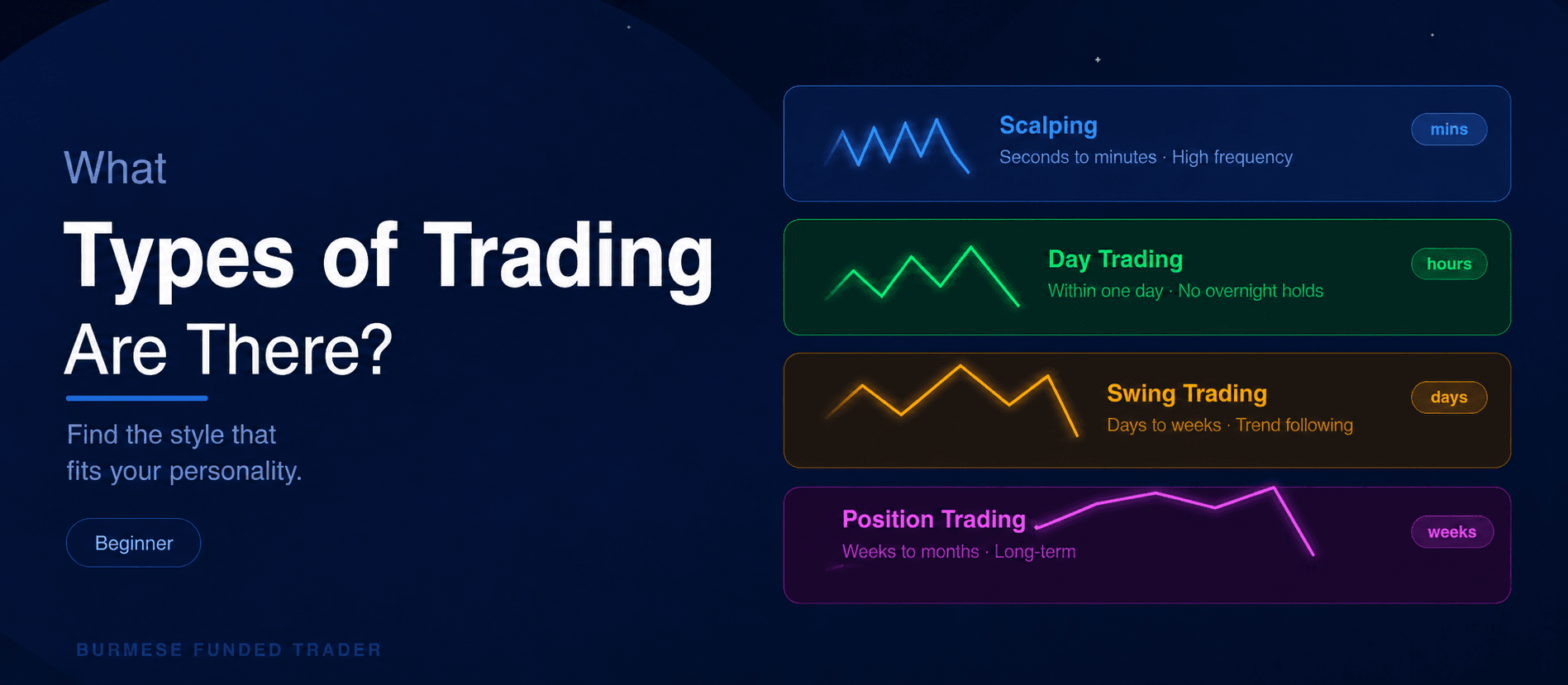
1. Scalping
Scalping is a very short-term trading style.
Scalpers may enter and exit trades within seconds or minutes. They usually look for small price movements.
This style requires:
- Fast execution
- Strong focus
- Strict risk control
- Low emotional reaction
Scalping is not ideal for traders who cannot make quick decisions or who overtrade easily.
2. Day Trading
Day trading means opening and closing trades within the same day.
Day traders usually do not hold trades overnight. They focus on intraday price movement and active market sessions.
This style is popular because traders can finish their trading day without holding open positions overnight.
But day trading still requires discipline. More trades do not automatically mean better results.
3. Swing Trading
Swing trading means holding trades for several days or sometimes weeks.
Swing traders look for larger price moves and do not need to watch the chart every minute.
This style requires patience. Traders must be comfortable holding through normal price movement while still managing risk.
4. Position Trading
Position trading is a longer-term style.
Position traders may hold trades for weeks, months, or longer. They often use broader market trends, economic data, or long-term technical analysis.
This style is slower and usually requires a bigger-picture mindset.
Simple Example
Two traders may both trade gold, but their styles can be completely different.
Trader A is a scalper.
They enter gold for a short move and close the trade within a few minutes.
Trader B is a swing trader.
They analyze the larger trend and may hold the trade for several days.
Both are trading gold, but their time frame, risk plan, and decision-making process are different.
This is why traders should not copy another person’s trade without understanding the style behind it.
Common Mistakes
Common beginner mistakes include:
- Choosing a trading style only because it looks exciting
- Scalping without fast execution or discipline
- Swing trading without patience
- Trading crypto or gold without understanding volatility
- Using too much leverage
- Switching strategies too often
- Copying another trader’s style without understanding the risk
A trading style is not just about entry signals.
It must fit the trader’s personality, schedule, and risk control.
BFT Perspective
At BFT, we do not believe every trader needs to trade the same way.
Some traders are better suited for slower setups. Some are better at intraday trading. Some need more structure before they trade actively.
What matters most is not whether a trader scalps, day trades, or swing trades. What matters is whether the trader can follow rules, manage risk, and stay disciplined.
For evaluation trading, traders should choose a style that fits the account rules and risk limits. A strategy that works on a personal account may still fail an evaluation if the trader ignores drawdown, stop loss, margin, or risk exposure rules.
Key Takeaways
- Trading types can be grouped by market and by time frame.
- Common markets include forex, commodities, indices, stocks, and crypto.
- Common styles include scalping, day trading, swing trading, and position trading.
- No trading style guarantees profit.
- The best style is the one a trader can execute with discipline and proper risk management.